MRT is a structured group program that changes the beliefs driving your decisions. It's peer-led, meaning the group belongs to the group. People who've been where you are help you rebuild how you think so you can change the trajectory of your life.
You got paperwork from your probation officer or judge. It says you need to complete MRT. You have questions. What actually happens in class? How long does it take? What if you fail a step?
This article answers those questions using plain language. Every answer comes from Tiffini Wright, a Thinking for a Change trainer and CRADC with 20 years in the substance abuse field.

What Does MRT Stand For?
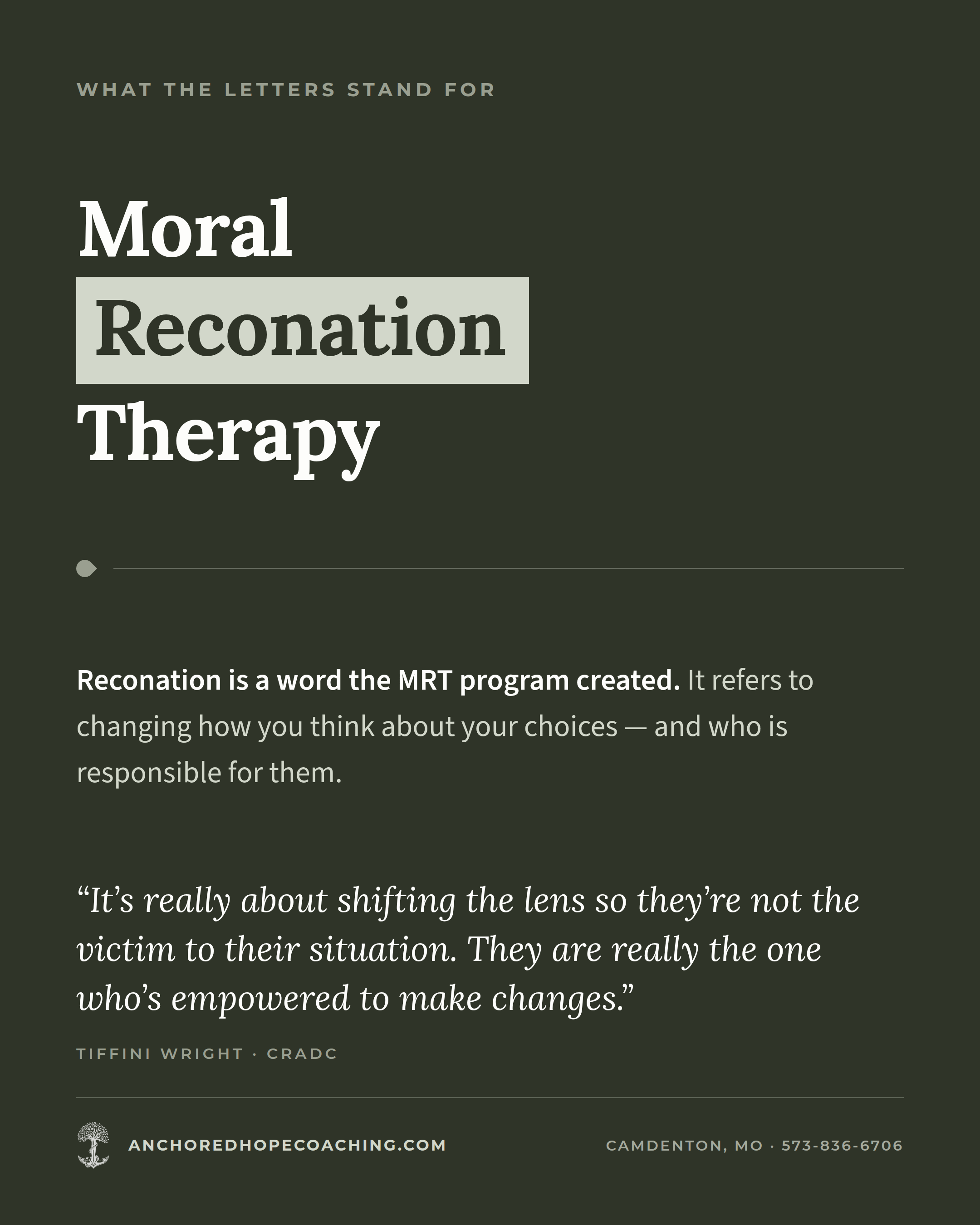
MRT means Moral Reconation Therapy. Reconation is a word the MRT program created. It refers to changing how you think about your choices and who is responsible for them.
"It's really about shifting the lens so they're not the victim to their situation. They are really the one who's empowered to make changes and change the trajectory of their life through stringent personal accountability," said Tiffini Wright.
Why Do You Keep Making the Same Bad Decisions When You Know Better?
You make the same bad decisions because of your beliefs about yourself and the world. Those beliefs were formed early in life. They shape how you see every situation.
"If I don't believe that I can be successful or I don't believe that I am loved, then I'm going to act as how I believe," said Tiffini Wright.
Here's an example. You see a purse on the street. Your first thought might be to return it. Someone else's first thought might be to take it. That difference comes from beliefs.
Maybe you were taught that taking care of others is right. Maybe someone else was taught that rich people are the enemy and you're a sucker if you give money back.
Why Changing Your Beliefs Is Uncomfortable
Changing a belief changes everything connected to that belief. It's uncomfortable even when the belief isn't serving you.
"When we have a belief, even if it's not serving us, it's very uncomfortable to change that belief," said Tiffini Wright. "Sometimes they don't even know what beliefs they're holding on to that cause them to keep going back to the old behavior."
MRT works by identifying those beliefs and changing them step by step. That's why the work is hard. You're not just learning new information. You're rebuilding how you think.
The Group Belongs to the Group
MRT is different from regular counseling or group therapy. The group is peer-led. The people who help lead it have been where you are. They've done the work. Now they're making progress on their own goals and dreams.
"The MRT group is a step program that is group facilitated. There's a facilitator in the group, but they just make sure that the group follows the group guidelines and keeps the process moving forward," said Tiffini Wright. "The group is really what holds people accountable and passes people on their steps."
Group members who are past step 3 vote on your presentation. They've already done the work. They know what the step requires.
"Other members in the MRT class that have made it through the steps really kind of challenge the newbies to come up and do the work because they've seen how doing the work has impacted and changed their perspective," said Tiffini Wright.
Your peers hold you accountable, not just a counselor. You're in a room with people who understand. Everyone has a story. There's no judgment.
"You really are in a room of people who understand, and there is no judgment. Everybody's heard everybody's testimony and story," said Tiffini Wright. "It actually is quite a relief to be in a room where there's no judgment, supportive people, and people who've walked in your shoes."

What Actually Happens in an MRT Group Each Week?
MRT is a step program. You work on one step at a time outside of class. In class, you present your completed step to the group.
Here's what happens when you walk in:
- Sign up on the board to present your step that week
- Presentations begin — each person presents their completed step
- Group members vote on whether you pass (only members past step 3 can vote)
- Pair work or questions if there's time left after presentations
You don't have to present if you're not ready. The class is self-paced. Most of the class time is spent on presentations.
Some steps are presented only to the facilitator. Most steps are presented to the group. The group members who are ahead of you decide if you pass.

Why Courts Order MRT
The program was created in a prison setting for justice-involved people. It addresses criminal thinking errors. Courts order it because people who complete it show noticeable life changes. "People who complete the MRT do have really sustained, really noticeable life changes," said Tiffini Wright.
MRT is based on rigorous honesty and following rules. You make a commitment to follow the rules of your probation and the group. If you break that commitment, you redo the first three steps. Those steps cover honesty, accountability, and following rules. Then you continue where you left off. "It gives probation officers and judges an intervention that doesn't have to be punitive. It can be therapeutic," said Tiffini Wright.
What Should I Do Before My First MRT Session?
You don't need to do anything special. You won't present in your first week. You can't fall behind.
"You don't need to do anything because you won't fall behind because you can't even present on your first week at all," said Tiffini Wright.
When you get your MRT book, read the first 21 pages before your first class. That's it. No step work. No presentation.
Your first week is for listening and learning how the group works. You'll see other people present. You'll hear the facilitator explain the process.
What to Expect in Week One
- You'll get your MRT workbook
- You'll learn the group guidelines
- You'll watch other members present their steps
- You'll see how the voting process works
- You'll read the first 21 pages
That's all. No pressure. No presentation. Just observation.
How Long Does MRT Take and What Happens If I Don't Pass a Step?
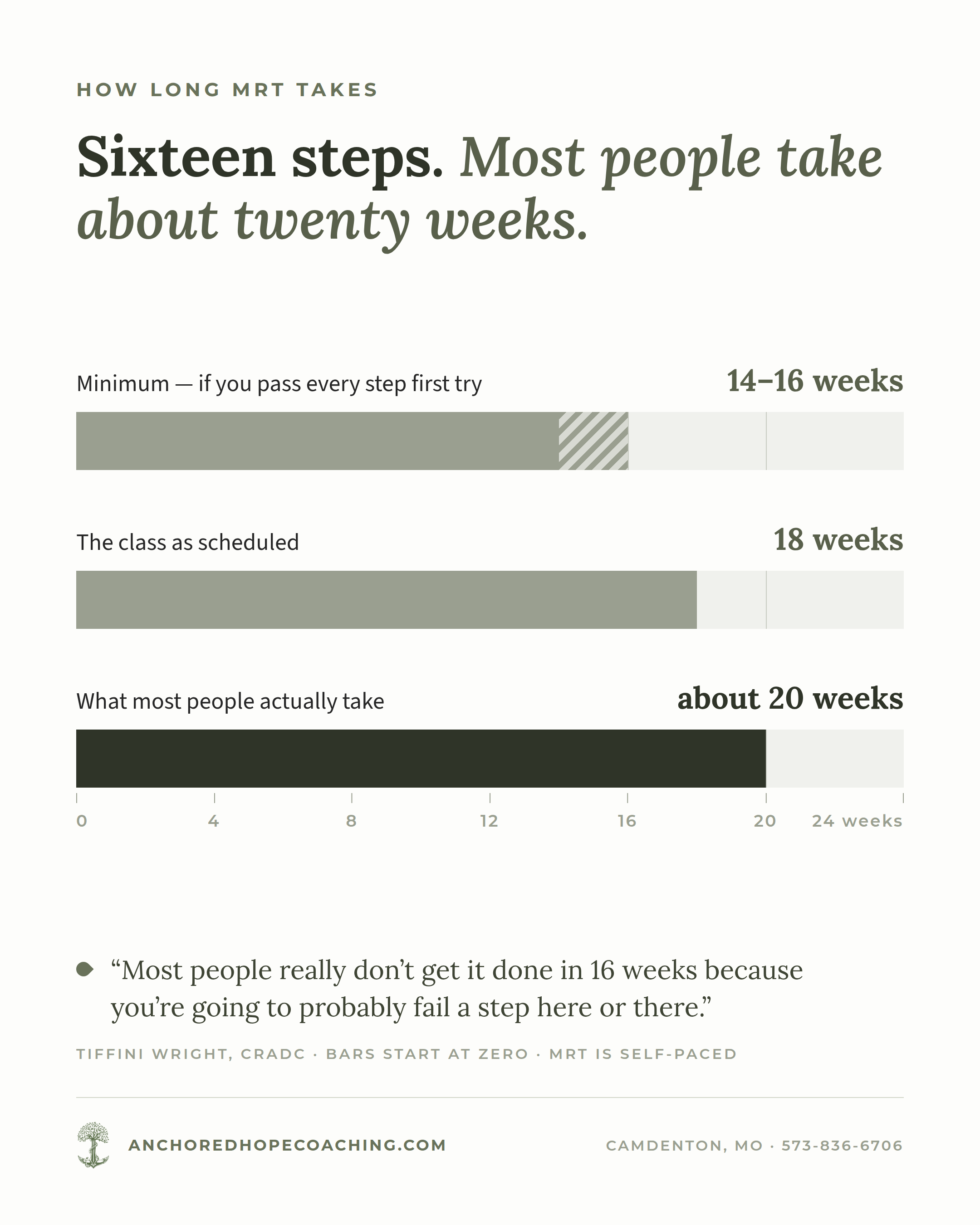
MRT has 16 steps. The minimum time to complete it is 14 to 16 weeks if you pass every step on the first try. Most people take around 20 weeks.
"The class itself is 18 weeks, but it's self-paced. You don't have to present a step if it takes you longer to do one," said Tiffini Wright. "Most people really don't get it done in 16 weeks because you're going to probably fail a step here or there."
Failing a step is normal. It's part of the process. You just present again the next week with the feedback the group gave you.
What Happens When You Don't Pass a Step
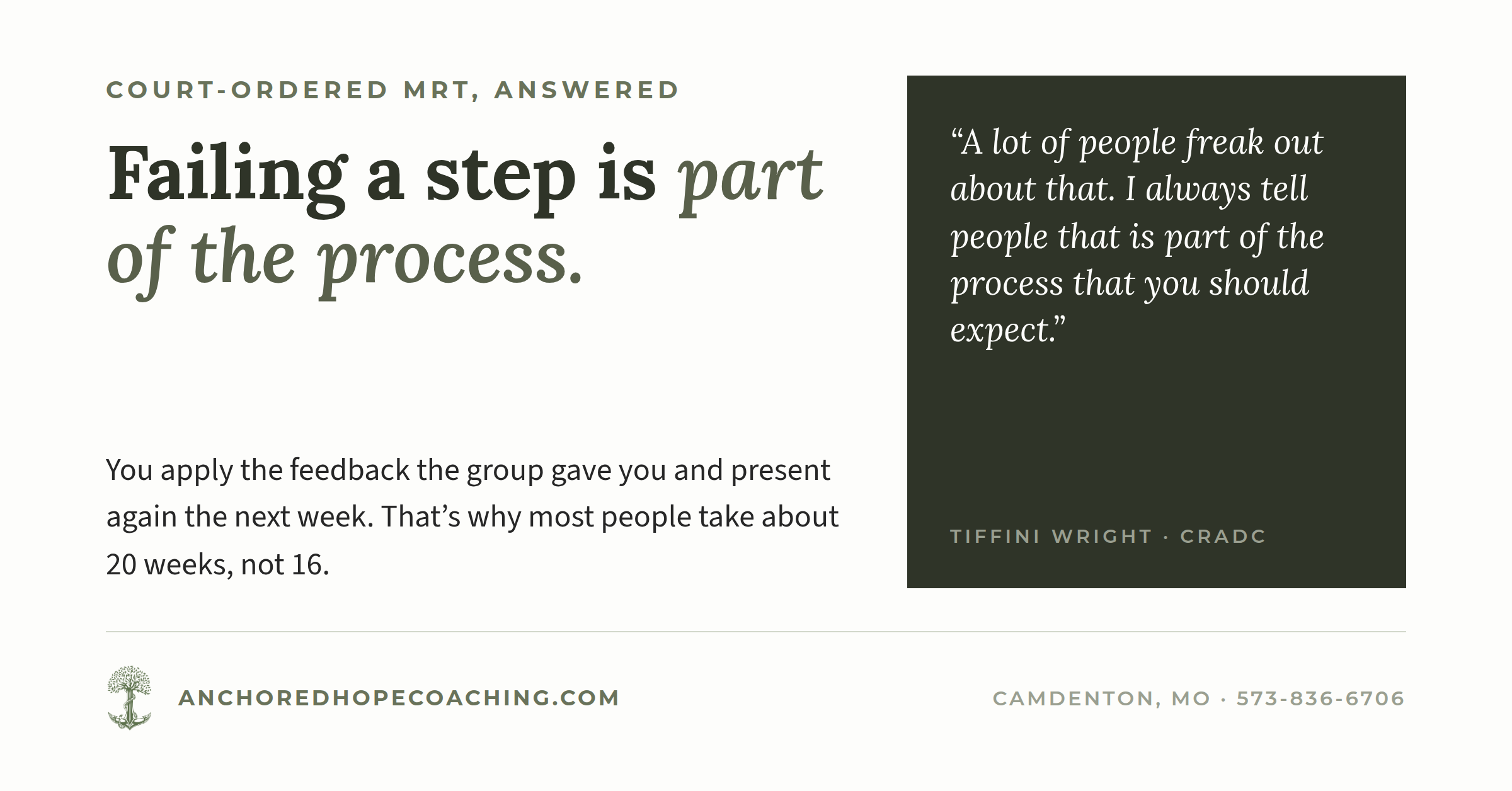
You apply the feedback and present again the next week. That's it.
"It's not a bad deal if you don't pass a step. A lot of people freak out about that. I always tell people that is part of the process that you should expect," said Tiffini Wright. "It's not really even about failing or passing. It's about just needing to go back and do deeper work."
If you're stuck on a step, you can:
- Reach out to a peer in the group who's further ahead
- Meet with your facilitator outside of class
- Take more time before presenting
The last few steps are lifelong steps. You keep working on them after you graduate.
What Do People Get Wrong About MRT When They Walk In?
Most people think MRT is just another group therapy session. It's not.
"I think they get wrong that it's another class and that it's just another group therapy session, which a lot of people have done a lot of those by the time they come to an MRT class," said Tiffini Wright. "For a lot of times, MRT is a class that will work for someone when nothing else has worked for them."
MRT is run by your peers, not just a counselor. One of the steps is presenting your story to the group. It's stressful. But people who do it see the benefit.
Frequently Asked Questions
Question: Can I work ahead on multiple steps at once?
No. You have to focus on one step at a time. You can't work ahead. Each step builds on the one before it.
Question: Do I have to talk in front of the group every week?
You only present when you're ready to show a completed step. Some weeks you'll just listen to others. Some steps are presented only to the facilitator, not the whole group.
Question: Can I do MRT if I'm not court-ordered?
Yes. There are versions of MRT for people who aren't justice-involved. Ask your counselor or treatment provider if they offer it.
Key Takeaways
- MRT is a 16-step program that changes how you think about decisions and accountability
- Courts order MRT because it was built for justice-involved people and produces noticeable life changes
- The group holds you accountable, not just a counselor — peers vote on whether you pass each step
- Failing a step is normal — you just apply feedback and present again the next week
- Most people take around 20 weeks to complete MRT, even though the minimum is 14 to 16 weeks
- You can't work ahead — you focus on one step at a time outside of class
- You don't present in your first week — just read the first 21 pages of your workbook
- For some people, MRT works when nothing else has, in Tiffini Wright's experience
When to Get Help
If you've been court-ordered to complete MRT, the best thing you can do is show up and trust the process. The work is hard. Changing your thinking patterns is uncomfortable. But people who complete MRT see real changes.
"I just wish that people would know that you have to just trust the process. It's very scary. One of the steps is presenting your story, and it's very stressful for people. But people in the class have been able to see the benefit of doing the work and working through the steps." — Tiffini Wright
Anchored Hope offers Moral Reconation Therapy (MRT) as part of court-recognized programs for probation and parole. Classes are held in Camdenton, Missouri, at 79 Sorrento Drive Unit 2 #5.
If you have questions about MRT or need to schedule your first class, contact Tiffini Wright or Tammy Knifong directly. A real person answers the phone, not a call center. Your first consultation is free.
Visit https://www.anchoredhopecoaching.com/ or call to get started. All substance use treatment records are protected by federal confidentiality law (42 CFR Part 2).
If you're in crisis, call or text 988 for the Suicide & Crisis Lifeline. Help is available 24/7.
Written from a recorded voice interview with the practitioner. Every quotation is her own words from that recording. Program facts were read against the MRT publisher's public description. The practitioner reads and approves the page before it is published.
Something wrong? Tell us and we fix it in the open.